3 min read
Be Where Your Feet Are: Why Chasing AEO Might Be the Wrong Climb
 Peter Platt
August 8, 2026
Peter Platt
August 8, 2026
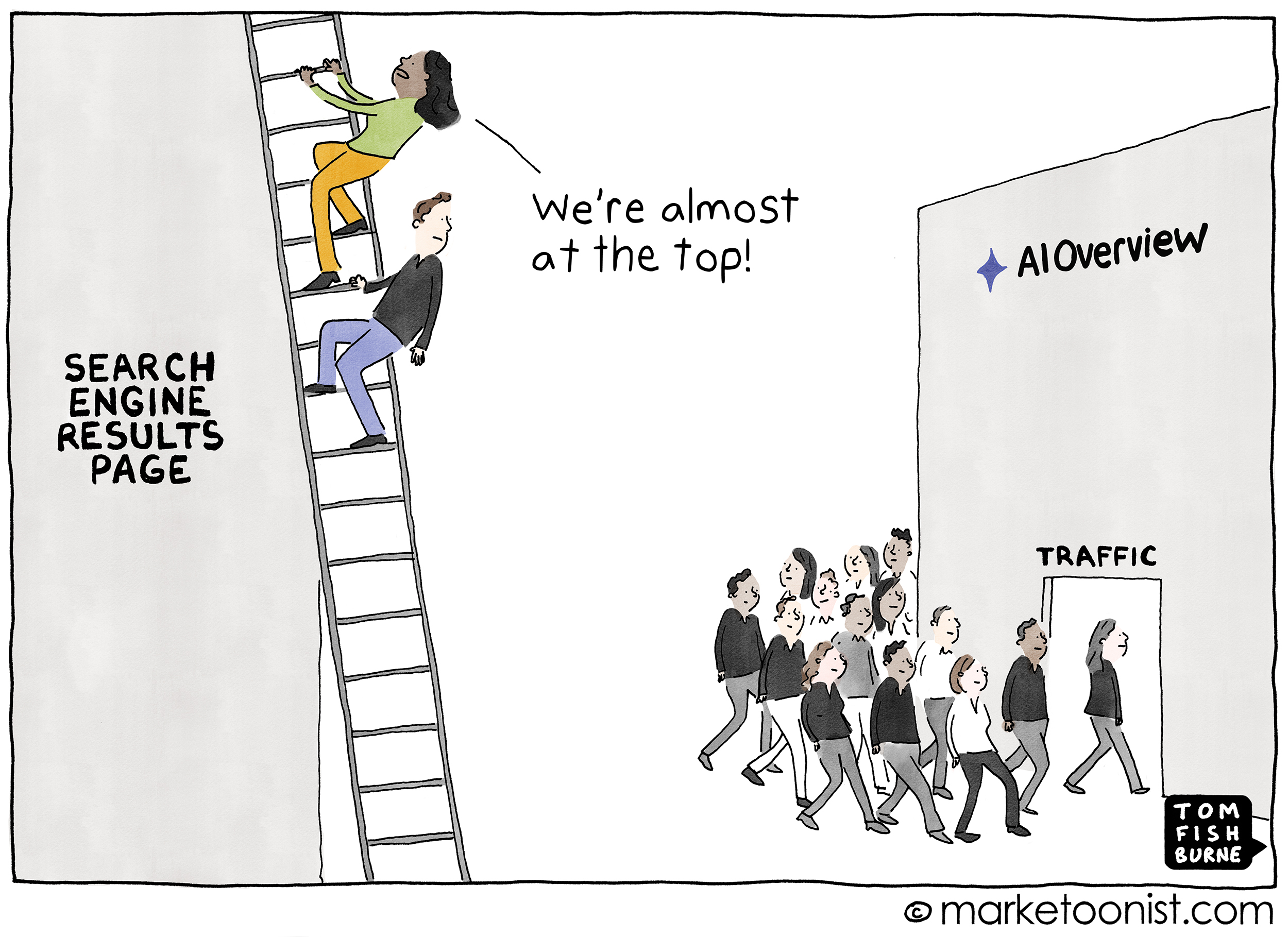
Look at this cartoon for more than a few seconds and the joke changes.
At first glance, it reads as a simple commentary on AI eating search traffic. Two marketers straining up a ladder, "We're almost at the top!" But look at what they're actually climbing. The ladder is bolted to the Search Engine Results Page building. They are working — hard — to reach the top of a structure that isn't where the crowd is going.
Because the crowd isn't climbing at all. They're walking, at ground level, straight through a door marked "Traffic," into an entirely different building next door: AI Overview.
That's the trap. Not that AI is replacing search. It's that a lot of very real effort is being poured into optimizing the wrong structure entirely — and mistaking that effort for progress.
The part that hasn't changed
Strip away the acronyms for a second — SEO, AEO, GEO, whatever comes next — and ask what any of it was ever actually for.
It was never about ranking. Ranking was a proxy. The real goal, the one that's been true since long before "search engine" was a phrase anyone used, is getting found by someone at the moment they have a question, a comparison to make, or a decision to move forward on. The mechanism has always been secondary to the moment.
That moment — the customer's need, their question, their trust threshold — hasn't moved. What's moved is the number of doors into the building.
More doors, same building
This is the nuance that gets lost when a leadership team declares "we need an AI strategy." AI Overviews, chat assistants, and traditional organic results aren't competing buildings requiring separate strategies bolted on as afterthoughts. They're different entry points into the same fundamental relationship between a business and a customer with a need.
A prospect asking ChatGPT to compare vendors and a prospect scrolling ten blue links are doing the same job: trying to build enough confidence to act. The surface changed. The job didn't.
I joke with clients that we've gone from SEO to GEO to AEO to... EI-EI-O. It usually gets a groan, but there's a real point buried in the joke: every new acronym invites a leadership team to treat it as its own initiative, with its own budget line, its own vendor, its own strategy deck. And that's exactly where the trouble starts.
Which means the anxious question a lot of marketing leaders are asking right now — "what's our AEO strategy?" — is often the wrong question, or at least a question asked one level too low. It treats a new door as a new building, and sends teams scrambling to build a separate ladder for it, instead of asking whether the foundation underneath the whole structure is strong enough to be found and trusted no matter which door someone walks through.
Be where your feet are
There's a Jason Mraz song called "Be Where Your Feet Are." The idea in it — relaxing into where you actually are instead of exhausting yourself chasing someone else's path — lands differently once you've spent time inside a marketing org during an AI panic.
Because that's exactly what's happening in the cartoon. The climbers are following "someone's way" — the established, familiar climb — while the people who actually matter already relocated. The effort isn't wrong because it's low quality. It's wrong because it's aimed at a structure the audience has already left.
Being where your feet are, translated into marketing terms, isn't about picking the trendiest channel. It's about honestly locating where your buyer's attention and trust actually sit today, and building your presence there — rather than defaulting to the climb you already know how to do because it's familiar, measurable, or what last year's plan said to do.
What this means Monday morning
Here's the irony worth sitting with: most teams aren't neglecting the ladder on the old building. They're racing to build a brand new one — against the AI Overview building — as if it needs its own separate climb, its own strategy deck, its own budget line, independent from everything else.
And that building is nowhere near finished. The rules of how AI Overviews and assistants select, cite, and trust sources are still being written in real time, shifting month to month. Bolting a freshly-built AEO ladder onto a structure that's still under construction is a strange place to be pouring disproportionate energy — especially while the foundation next door, the one that's actually earned trust for years, gets left to age.
AI Overviews and AI assistants still have to pull their answers from somewhere. They favor sources with real depth, real structure, and real authority on a topic — the same signals that have always separated a trusted source from a forgettable one. Being present in an AI-generated answer isn't a new discipline requiring its own ladder. It's a downstream reward for the same work: building genuine topical authority that earns trust regardless of which door the customer walks through.
So before your team drafts a standalone "AEO roadmap" or budgets for another point solution, it's worth asking a more uncomfortable question: are we building a second, wobblier ladder because it feels like progress — or are we strengthening the one foundation that was always going to hold up the whole building?
Consumer needs haven't changed. Just be where their feet are.
[Attribution: cartoon by Tom Fishburne, Marketoonist. Song reference: "Be Where Your Feet Are," Jason Mraz.]