 Peter Platt
1 min read
Why Effectiveness Outweighs Efficiency When Using AI in Marketing
 Peter Platt
In today’s AI-driven marketing landscape, there’s an obsession with efficiency—faster content production, automated responses, and instant...

AI is reshaping how marketing teams work, and most of that change is for the better. But there's a quieter risk that comes with it, one that doesn't get talked about enough: the tendency to trust AI output simply because it sounds confident and arrives quickly.
This is called automation bias, and researchers have studied it for decades in fields like aviation and medicine. It's the well-documented human habit of over-trusting automated systems, even when something doesn't quite add up. Now it's showing up in marketing departments, where AI-generated insights are increasingly shaping campaign strategy, audience targeting, competitive analysis, and budget decisions.
At Accountable Digital, we believe AI is a powerful tool when used thoughtfully. But we've also seen how easily marketing leaders can be misled when AI output gets treated as fact rather than a starting point.
Marketing is a fertile environment for automation bias, for a few reasons.
First, marketing decisions are often made under ambiguity. Unlike a financial close or a legal review, there's rarely one correct answer. When AI returns a confident-sounding recommendation about segmentation or messaging, there's no immediate ground truth to push back on. The output just becomes the input for the next decision.
Second, AI writes really well. Large language models produce prose that reads like it came from a top-tier consulting deck. Fluency gets mistaken for accuracy, and a smoothly written fabrication is harder to challenge than a hesitant one.
Third, the productivity gains are real. AI genuinely saves time on research synthesis, first-draft copy, and ideation. That earned trust on the easy stuff leaks into unearned trust on the harder stuff, where verification matters most.
 What Goes Wrong When Verification Lapses
The failure modes are predictable, and most marketing teams have already run into at least one.
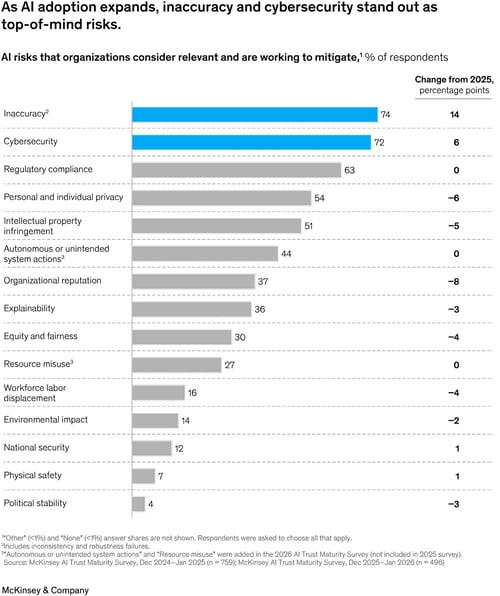
Fabricated statistics. An AI tool produces a "study" showing that 73% of B2B buyers prefer a particular channel. The number is invented, the source is invented, but the citation reads cleanly enough that it ends up in a board deck. When someone asks for the original source, the trail goes cold.
I ran into this directly while writing this post. Multiple AI tools confidently cited a "$67 billion cost to global business" figure attributed to AI hallucinations. I couldn't trace it to a primary source no matter how I searched. The number had the texture of a real statistic, round and specific-ish and attributed vaguely to "industry research," but the trail dead-ended every time. That's the exact failure mode this post is about, and it happened in the process of writing about it.
Confident misreads of competitive positioning. AI-generated competitive analyses often conflate companies, hallucinate product features, or describe positioning a competitor has since abandoned. A strategy built on this kind of analysis is a strategy built on a competitor that doesn't exist.
Plausible-but-wrong audience insights. AI can generate a persona that sounds rich and specific, with demographics, pain points, media habits, and objections, without any underlying data. That persona becomes the foundation for creative and channel decisions, and the campaign underperforms for reasons no one can diagnose.
Aggregated errors in reporting. When AI is layered onto marketing analytics, small misinterpretations compound. A wrongly classified channel, a misread conversion definition, a hallucinated benchmark, each one shifts a recommendation by a few degrees, and the drift adds up by the time it reaches the CMO.
This same discipline applies outside of AI, and it's worth pointing out because it illustrates exactly what good verification looks like.
Most marketing platforms report a "conversion" number as if it were ground truth. Google Ads says you got 47 conversions, Meta says 31, HubSpot says 52. But anyone who has actually opened the underlying lead form submissions knows the real picture is messier. Some of those conversions are spam. Some are existing customers filling out the wrong form. Some are job applicants. Some are competitors. Some are genuinely qualified leads.
At Accountable Digital, we review actual form submissions for our clients rather than just accepting the platform's conversion count. Reading them, classifying them, and separating signal from noise is how a reported number becomes a real finding. The same principle applies to AI output, only more so.
The most useful shift for marketing leaders is this: AI generates hypotheses. Humans verify them into findings.
A hypothesis is a starting point. A finding is something you can act on. The discipline of getting from one to the other is what separates organizations that use AI well from those that get burned by it.
In practice, that means a few things.
Every AI-generated statistic gets traced to a primary source, and if the source can't be found, the statistic doesn't make the deck.
Every competitive claim gets checked against the competitor's actual website or recent earnings calls.
Every audience insight gets validated against your own first-party data.
Every strategic recommendation gets stress-tested by someone whose job it is to disagree.
This is slower than just accepting the output. It's also much faster than rebuilding a campaign that failed because its premises were fiction.
 Building Verification Into Your Operating Model
The goal isn't to slow your team down. It's to embed verification into the workflow so the productivity gains from AI don't get cancelled out by avoidable mistakes.
A few principles tend to hold up. Define which decisions require what level of verification. A subject line for an A/B test is low-stakes. An AI-summarized market sizing for next year's budget is not. The same level of scrutiny applied to both will either over-burden the small or under-protect the large.
Make sources non-negotiable. If a piece of AI output is going to influence a real decision, the underlying sources need to be visible and verifiable. An AI tool generating it is not the same as a source supporting it.
Preserve the friction. The slowing-down to verify is a feature, not a bug. Junior marketers sometimes accept AI output without challenge because they don't have the experience to spot what looks wrong. Senior marketers sometimes do the same because they're using AI outside their core expertise. Both are addressable, but only if your team treats verification as part of the job.
AI isn't going away, and the marketing leaders who refuse to use it will fall behind the ones who use it well. But using it well is a real skill, not a default state. The teams that develop that skill will be the ones that treat AI as a powerful collaborator whose work, like any collaborator's, deserves review.
The marketing leaders who can't afford to slow down to verify are the ones who can least afford to skip it. The cost of acting on bad AI output, whether it's a fabricated statistic, a mischaracterized competitor, or a fictional audience insight, almost always exceeds the time it would have taken to check. Verification isn't a tax on AI's productivity. It's what makes the productivity real.
At Accountable Digital, we've built verification into how we work with AI across our client engagements. If you'd like a short checklist of quick human-verification steps your team can apply to AI outputs before they shape decisions, let's talk.

1 min read
In today’s AI-driven marketing landscape, there’s an obsession with efficiency—faster content production, automated responses, and instant...

1 min read
Search is no longer what it used to be. What was once a list of blue links has transformed into an interactive conversation—one powered by artificial...

1 min read
Why the real opportunity isn't letting AI think for us, but learning to think better with it.