
6 min read

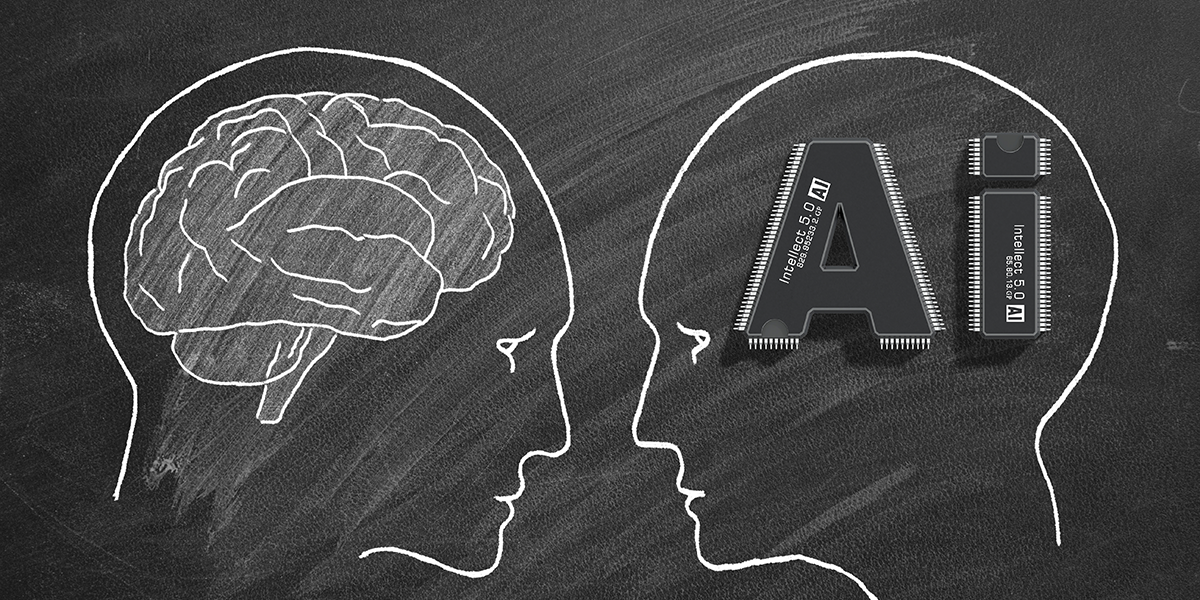
AI Is Getting Better at Thinking. Are We?

AI Is Getting Better at Thinking. Are We?
12:40

Why the real opportunity isn't letting AI think for us, but learning to think better with it.

I recently took AI for Writers, a course taught by Christopher Penn of Trust Insights, with a simple expectation: I'd learn how to teach AI to write like me.

I got a lot more than I expected.

As always, Penn's course gets pretty technical, covering everything from Python scripts and markup files to multiple LLMs and different research modes. But what struck me was how much attention he gave to the process and work that should happen before generating a draft. Developing the concept. Understanding the audience. Researching the subject. Evaluating different perspectives. Building an outline. And only then generating drafts.

It was a reminder of something I've believed for a long time: The quality of the thinking that goes into something has a lot to do with the quality of what comes out.

Before AI, my typical writing process involved reading somewhere between five and fifteen articles about a subject. I'd look for common themes, consider different opinions, and overlay what I'd learned with my own experiences working with clients. Sometimes I agreed with the prevailing thinking. Other times, something struck me as completely missing the point.

Those exceptions were often where the most interesting articles began.

Today, AI can help me research a much wider range of material in a fraction of the time. It can identify trends, summarize competing arguments, uncover contradictions, and introduce ideas I might never have encountered on my own.

That's an extraordinary improvement in what I can accomplish.

But there's a question worth asking: Does having access to more sophisticated answers actually make us better thinkers?

Getting the Answer Isn't the Same as Understanding It

I've always believed that foundational knowledge matters, which is one reason I became involved with XtraMath, a nonprofit organization whose board I serve on.

XtraMath helps children develop fluency with basic mathematical facts. The premise is straightforward: when students can recall basic arithmetic without struggling through every calculation, they have more mental capacity available to tackle increasingly complex problems.

Think about calculators. We've been doing mathematical calculations with them for decades, and I'm certainly not suggesting we should give them up. But knowing how to multiply two numbers isn't the same as understanding which numbers should be multiplied, why, or whether the resulting answer makes sense.

AI takes this concept to an entirely different level. It's capable of far more than a calculator, including analyzing complex problems and recommending solutions.

So what happens when we start relying on it before we've developed the foundational knowledge needed to understand those solutions?

A 2025 study published in the Proceedings of the National Academy of Sciences offers an interesting perspective.

Researchers gave nearly 1,000 high school students access to AI tools while practicing mathematics. Students using the tools performed better during practice. But when AI assistance was removed, students using an unrestricted AI helper scored 17% worse than students who hadn't used AI at all.

Interestingly, a different version of the tool, designed to provide guidance and hints rather than simply supplying answers, largely avoided that decline.

Now, this was a study involving students learning mathematics, not marketing executives making business decisions. But the distinction between completing a task and developing an understanding of it is worth considering.

If a junior marketing analyst uses AI to prepare a campaign performance report, that's probably a very good use of the technology. But if they don't understand attribution, conversion quality, or the relationship between marketing activities and actual business results, how will they recognize when the conclusions don't make sense?

More importantly, if AI performs that analysis every week, where will they develop the expertise they'll need to make more complex decisions later in their careers?

I'm not suggesting that everyone needs to do everything manually before they can use AI. But we shouldn't confuse eliminating unnecessary work with eliminating the need to learn.

Is Human Involvement Always Better?

Before we get too carried away with the importance of human thinking, there's another question we need to address.

What if AI is simply better at doing the work?

A 2024 study published in Nature Human Behaviour analyzed 106 experiments comparing humans working alone, AI working alone, and humans working with AI.

The researchers found that human-AI combinations generally performed better than humans alone, but worse than whichever of the human-only or AI-only approaches performed best.

In other words, adding a person to the process didn't automatically improve the result.

A separate 2026 study involving 791 professionals at Procter & Gamble found that individuals working with AI produced innovation proposals comparable in quality to those developed by traditional two-person teams without AI.

That's a pretty compelling argument for the capabilities AI brings to the table.

But the P&G research also uncovered something interesting. While AI improved the overall quality of ideas, participants using AI were less effective at identifying their own strongest ideas than those working without it.

So AI helped produce better possibilities, but it didn't necessarily improve the participants' ability to evaluate them.

Does that mean human judgment is always better? Of course not. AI can identify patterns, challenge assumptions, and evaluate alternatives extraordinarily well. And its capabilities will continue to evolve.

The more interesting question is whether the process we're using produces a better outcome.

Sometimes AI's answer may be perfectly sufficient. Other times, the value comes from investigating an alternative perspective, bringing additional context into the analysis, or recognizing an opportunity that wasn't part of the original question.

We need to get better at knowing the difference.

AI Can Be a Thought Partner. Are We Treating It Like One?

One of my concerns about AI isn't that it's going to replace human thinking. It's that we're going to become so comfortable with its capabilities that we stop exercising our own.

And there's research suggesting this is a legitimate concern.

A 2025 Microsoft Research study surveyed 319 knowledge workers about their use of generative AI. Researchers found that people who expressed greater confidence in AI also reported engaging in less critical thinking when using it.

That doesn't prove AI is making people less capable of thinking critically. But it raises a question about how readily we accept its conclusions.

Consider what happens when you ask AI to research an unfamiliar subject.

It can present an impressive summary of what experts believe, identify major trends, and explain the reasoning behind different positions. In many cases, that's exactly what we need.

But the prevailing opinion isn't always the most interesting one.

In my experience, some of the best business opportunities come from recognizing something that doesn't fit the conventional wisdom. A small but emerging trend. An overlooked audience. A marketing channel that's being evaluated against the wrong objective.

AI is capable of identifying those exceptions, too. But we need to make them part of the conversation.

What assumptions are we making? What evidence contradicts the recommendation? What might we be overlooking? Are there other ways to approach the problem?

These are questions I increasingly find myself exploring with AI, rather than simply asking it for an answer.

In fact, that's how this article came together. What started as a fairly straightforward idea about AI supporting rather than replacing human thinking evolved through research, discussion, and challenging some of my original assumptions.

And the evidence didn't always support what I initially believed.

That's a good thing.

The value of a thought partner isn't that they always agree with you. It's that they help you see something you might otherwise have missed.

What Does This Mean for Marketing Leaders?

For marketing executives, this conversation goes well beyond how we write articles or prepare reports.

AI is changing how marketing organizations operate, how responsibilities are distributed, and what capabilities we need from both internal teams and external partners.

And I think we need to be careful about how we evaluate that change.

If your team can produce twice as many campaigns, reports, or content pieces with AI, that's an impressive productivity improvement. But are those additional activities helping you achieve your business objectives?

What if AI recommends increasing investment in paid search because it's generating the lowest cost per conversion? That might be exactly the right recommendation.

But what if much of that performance comes from branded searches generated by an awareness campaign running elsewhere? Would moving budget away from that campaign ultimately undermine the very results you're trying to improve?

AI can certainly help investigate that relationship. The challenge is making sure we're asking the right questions and providing the business context needed to evaluate the answers.

The same principle applies to agency relationships.

I've always thought of our role at Accountable Digital as being marketing Sherpas. Our clients have a destination in mind, and our job is to help them get there. We've traveled similar paths many times, understand the terrain, and can help identify challenges and opportunities along the way.

But the accomplishment belongs to the client.

AI gives all of us access to better tools, more information, and new ways to evaluate the journey. That should make both marketing teams and their agency partners more capable.

It should also change what clients expect from those relationships.

If an agency is simply using AI to produce more deliverables, is that something you couldn't accomplish yourself?

Perhaps.

But if a partner is helping you challenge assumptions, recognize opportunities, explore different strategies, and make more informed decisions, the value of that relationship goes well beyond producing the work.

Of course, the partner needs to demonstrate that value through results, not just claim it.

Ultimately, we should be evaluating our investments in AI, our teams, and our agency relationships against the same standard: Are they helping us make better decisions and achieve better business outcomes?

Are We Becoming Better Thinkers?

I'm tremendously optimistic about what AI makes possible.

We have access to technology that can help us learn faster, explore subjects more deeply, consider perspectives we might otherwise overlook, and accomplish things that would have been impractical just a few years ago.

But having those capabilities available doesn't automatically mean we're taking full advantage of them.

If we simply accept what AI produces, we're potentially giving up one of its greatest benefits: the opportunity to challenge and expand our own understanding.

That brings me back to Christopher Penn's writing course (which I highly recommend).

I went into it expecting to learn how to make AI write more authentically in my voice. I came away inspired by something much more valuable: the opportunity to use AI to challenge my thinking, expand my understanding, and ultimately make my writing more meaningful to the people reading it.

And I think that's the larger opportunity for all of us.

Whether we're writing an article, developing a marketing strategy, or evaluating a business investment, the objective shouldn't simply be to get an answer faster. It should be to make a better decision.

AI gives us an extraordinary thought partner. One that can help us explore ideas, question assumptions, and recognize possibilities we might otherwise overlook.

But we have to be willing to participate in the thinking.

AI is getting better at thinking. Are we using it to become better thinkers, too?

Why Effectiveness Outweighs Efficiency When Using AI in Marketing

1 min read

Why Effectiveness Outweighs Efficiency When Using AI in Marketing

In today’s AI-driven marketing landscape, there’s an obsession with efficiency—faster content production, automated responses, and instant...

Read More
B2B Marketing Has Changed - Have You?

1 min read

B2B Marketing Has Changed - Have You?

The last five years have forced B2B marketers to rethink nearly every aspect of how they reach and engage their audience. What worked in 2019...

Read More
5 things great bosses always do

1 min read

5 things great bosses always do

The digital industry is comprised of an odd bunch of characters. There are the data folks who love to look at numbers, the technology folks writing...

Read More